

Let notes ring between chord changes
Open, suspended, and add9 voicings can preserve notes across several chords. Those shared notes make the changes feel connected instead of sounding like four completely separate chord shapes.
Guitar chord progressions
Shoegaze does not rely on one secret chord progression. Many shoegaze guitar parts begin with familiar major, minor, modal, or power-chord movement. The character comes from the voicings, notes that continue ringing between changes, repeated shapes, dynamics, and the effects added after the guitar part works on its own.
Want more shoegaze ideas? StrumForge Premium includes a Shoegaze Style for generating your own progressions.
The eight original four-chord progressions below use chord types available in StrumForge. Play each example, view its guitar diagrams, and open it in the generator when you want to change the key, tempo, groove, or chord voicings.
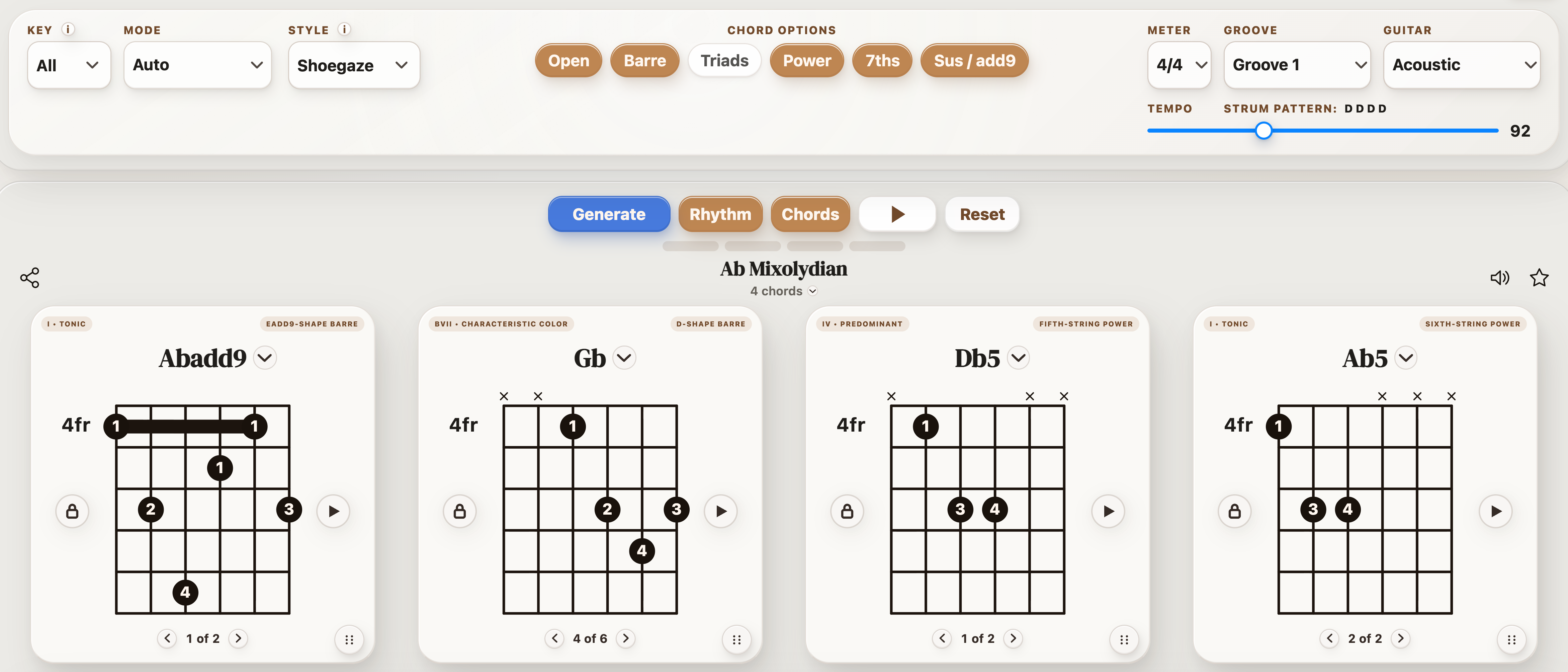
Open any example in StrumForge to hear the progression, view its guitar diagrams, and try different supported voicings.
Open, suspended, and add9 voicings can preserve notes across several chords. Those shared notes make the changes feel connected instead of sounding like four completely separate chord shapes.
Seventh, suspended, and add9 chords can soften an ordinary major or minor progression. Choose a related set of voicings rather than adding a different extension to every chord without a musical reason.
Moving the same type of barre chord, triad, power chord, or seventh-chord shape around the neck can create a drifting sound that is less predictable than a conventional open-chord progression.
Shoegaze harmony does not need to be complicated. A simple progression often works better when the guitarist plans to add sustained notes, distortion, reverb, delay, modulation, or an additional guitar layer outside StrumForge.
Play the chords clean first. Listen for awkward transitions, accidentally muted strings, or one chord that pulls too strongly away from the rest of the loop. Effects should expand a convincing guitar part rather than hide a weak one.
Yes. Alternate tunings are common in shoegaze, but they are not required. Standard tuning already provides open strings, suspended chords, add9 voicings, movable barre chords, triads, sevenths, and power chords.
Every example on this page works with StrumForge’s standard guitar diagrams. When choosing a voicing, listen for notes that can continue ringing across more than one chord. Shared notes often make a progression feel more atmospheric without changing its underlying harmony.
Play the progression without effects and make sure the transitions sound intentional. Try a different supported voicing if one chord interrupts the flow of the loop.
Use sustained downstrokes, slow arpeggios, muted eighth notes, or a repeated rhythmic figure. A consistent rhythm helps the four chords feel like one complete part.
The same four-chord progression can support a quiet section and a much louder section. Increase picking intensity, sustain, or the number of guitar layers before assuming the song needs additional chords.
After the progression works cleanly, experiment with reverb, delay, modulation, distortion, or fuzz to change its texture without rewriting the harmony.
A high triad, repeated two-note figure, or simple melody can sit above the progression. It does not need to repeat every chord tone already present in the rhythm part.
With StrumForge Premium, select Shoegaze in the Style menu to generate more ideas. Set Mode to Auto for a broad starting point. Enable Sus / add9 and 7ths to explore suspended and extended chord colors. Compare voicings, let shared notes ring, and develop the guitar texture with your own playing and effects. Style guides new progressions within your selected key, mode, and chord options.
Explore more starting points, then bring the chord sequence back to StrumForge to compare playable voicings.
Shoegaze can use ordinary major, minor, and power chords alongside suspended, add9, and seventh-chord voicings. The sound depends as much on voicing, sustain, dynamics, and texture as it does on the chord names.
No. A four-chord loop using major, minor, or power chords can work well. Seventh, suspended, and add9 options add color, but they are not required for every chord.
Yes. All eight examples are designed for the standard-tuning guitar diagrams available in StrumForge.
Open chords are useful when you want ringing strings and familiar shapes. Barre chords, triads, and power chords are useful for movable shapes, parallel movement, and heavier guitar parts.
Change the voicings and rhythm before replacing the entire progression. Try suspended or add9 options, use seventh chords consistently, preserve a ringing upper note, move a shape to a different register, or change the dynamics between sections.
Yes. Each example includes playback and a direct link that opens the four-chord progression in StrumForge with guitar diagrams and customization controls.