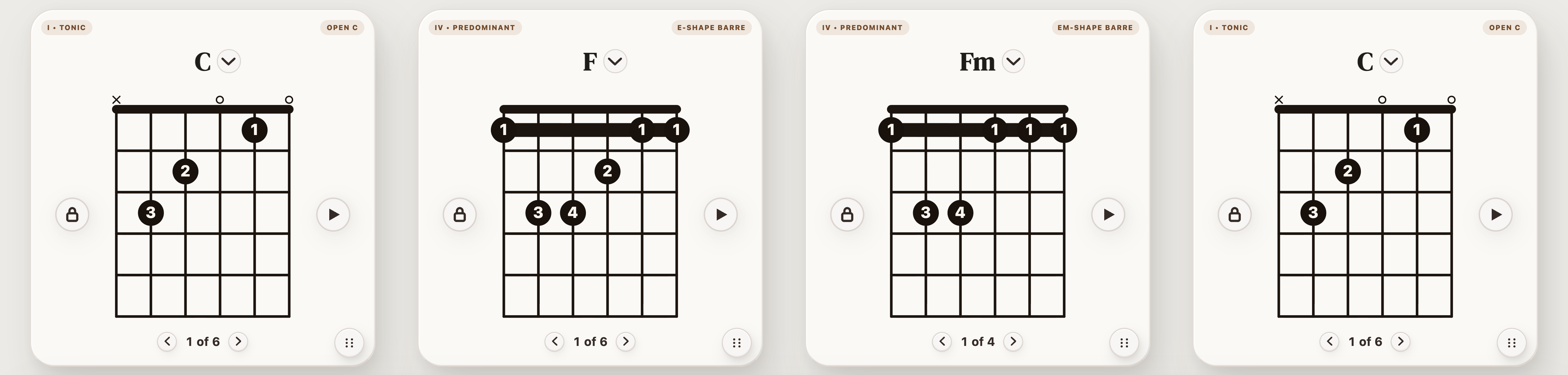
Major IV becomes minor iv: C – F – Fm – C
Listen to A in F fall to A♭ in Fm, then to G in C. That descending line gives the return its bittersweet pull.


Guitar lessons · Updated September 10, 2026
Modal interchange borrows a chord from a parallel mode while keeping the same tonal center. On guitar, a useful first example is C–F–Fm–C: F minor comes from C minor, and its A♭ changes the color of an otherwise major-key phrase.
Listen to A in F fall to A♭ in Fm, then to G in C. That descending line gives the return its bittersweet pull.
A♭ and B♭ are borrowed from C natural minor. Compare the broad whole-step B♭–C return with the stronger leading-tone pull of G7–C.
D major supplies F♯, the raised sixth associated with A Dorian. Keep A minor as home while comparing D major with D minor.
You do not need to change the entire scale for every borrowed chord. Start by following its chord tones; the arpeggio lesson explains how to locate them.
Borrowing changes a chord’s color without necessarily establishing a new key. Modulation establishes a new tonal center. A secondary dominant creates a temporary pull toward another chord: E7–Am in C major is a typical example.