Guitar Practice: Exercises for Chords, Rhythm & Scales
Good guitar practice starts with one specific task: make a chord change arrive on time, keep a strumming pattern steady, or hear where a phrase should land. Use this guide to choose your next exercise, then connect it to a musical loop. You do not need to practice every skill in every session.
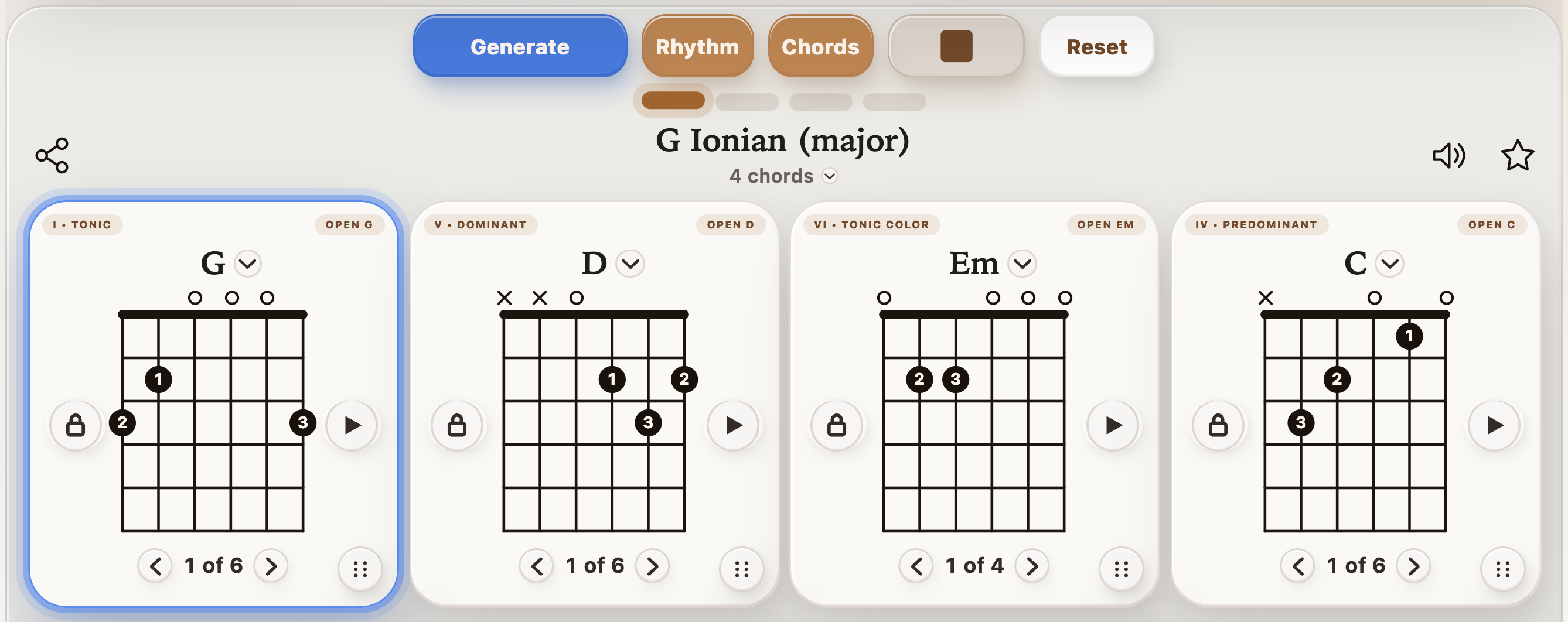
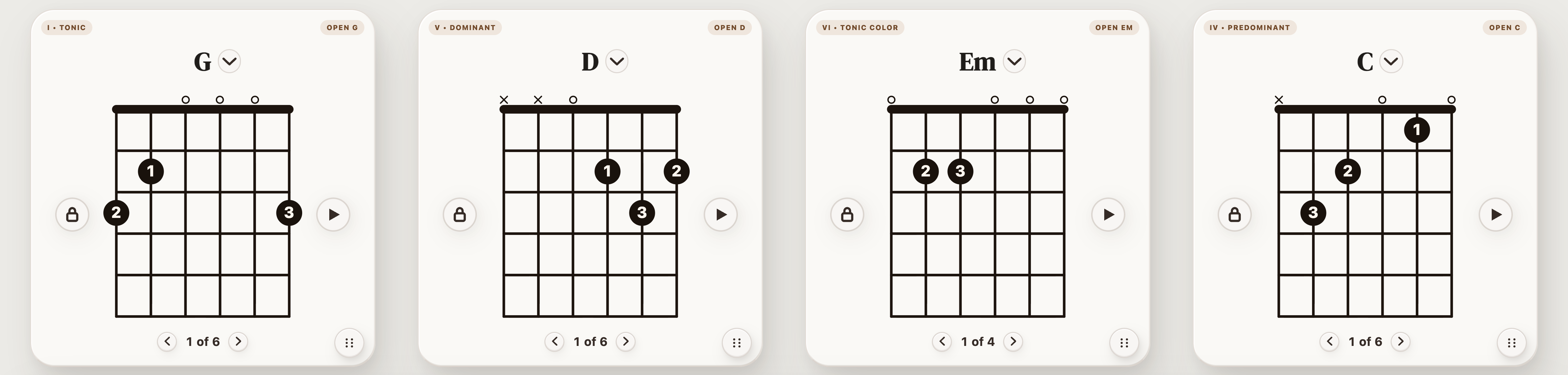
Follow the active chord through a repeating progression as you practice changes and timing.
Use one chord per bar in 4/4. Begin around 60 BPM, or slower if the change is late. Play through the return from C to G: the loop has four transitions, not three.
On the first pass, listen for the weakest transition. On the next pass, keep the counting going even if you miss it. Then stop and practice only that pair. Return to all four chords when the pair feels controlled. A metronome checks your pulse; a backing loop also gives the change a harmonic destination.
Use the same shapes for a few passes before deciding whether to change a voicing.
Try this ten-minute session
Swipe or scroll sideways to see all columns.
Time
Exercise
What to notice
0–1 minute
Tune and pick the notes of your first two chords individually.
Clear notes and quiet unused strings.
1–4 minutes
Alternate your hardest chord pair every four beats.
Arrive on beat one without stopping the count.
4–7 minutes
Return to the whole loop with one downstroke per beat.
Keep the last-to-first transition in time.
7–9 minutes
Play a three-note melody over the loop.
Listen to how one note sounds over different chords.
9–10 minutes
Write down the chord pair, tempo, and next step.
Choose tomorrow’s first exercise.
Need more structure? The daily routine guide expands this into 20- and 30-minute plans. If a new shape causes discomfort, release it and choose an easier voicing rather than repeating with extra tension.
Match the practice tool to the exercise
Swipe or scroll sideways to see all columns.
Practice goal
Useful StrumForge tools
A concrete next step
Tune before playing
Tuner with Standard, drop, open, and DADGAD presets.
Choose the tuning first, then check each string. Chord examples in these guides use Standard tuning unless stated otherwise.
Clean chord changes
Progression playback, tempo control, shape selectors, and chord locks.
Keep the chords fixed while you compare two comfortable fingerings.
Steady timing
Metronome subdivisions, accents, swing, tempo trainer, and silent bars.
Start with quarter notes; add one difficulty at a time.
Fretboard knowledge
Triad Trainer and Arpeggio Trainer.
Name the root, third, and fifth before following the playback.
Melodic playing
Scale shapes, note labels, and timed scale practice.
Learn the shape, then target a different chord tone on each bar.
Consistent sessions
Favorites, folders, and practice history.
Revisit the same exercise and compare matching tempos and conditions.
These exercises work with a guitar and a steady pulse. StrumForge offers free progression generation within its daily allowance. Interactive triad and arpeggio trainers, advanced scale playback, the dedicated metronome, tuner, favorites, and practice tracking require StrumForge Pro. Compare the app features and access options.
Decide when to make the exercise harder
Change only one variable at a time. After three clean loops, try a small tempo increase, such as 5 BPM, or move the exercise to a new key. If timing or clarity falls apart, return to the last controlled setting. This is a practice rule you can adjust, not a required rate of improvement.
For chord changes, count clean arrivals at a fixed tempo. For rhythm, record a short pass and listen for rushing through rests. For scale work, check whether you can name the target note before playing it. Minutes practiced are useful context, but they do not replace listening.
Common guitar practice questions
What should a beginner practice first?
Start with tuning, two comfortable chord shapes, and a steady count. Add more chords after the first transition is reliable. Easy chord transitions can help you choose pairs.
Do I need an app to follow these exercises?
No. A guitar, a metronome, and a written note are enough to begin. The app combines playback, diagrams, trainers, and saved ideas when you want those tools together.
Should I practice scales, triads, or arpeggios?
Choose the skill your music needs. Scales give you a note collection, triads show compact harmony, and arpeggios connect the chord tones separately. Practice one, then use it over a loop.