

Modal center
Treat the first chord as home when practicing mixolydian guitar progressions. Return to it often so the mode does not collapse into ordinary major or minor harmony.
Guitar modes
Explore mixolydian guitar progressions with guitar-focused examples, voicing notes, practice suggestions, songwriting angles, and direct StrumForge generator links.
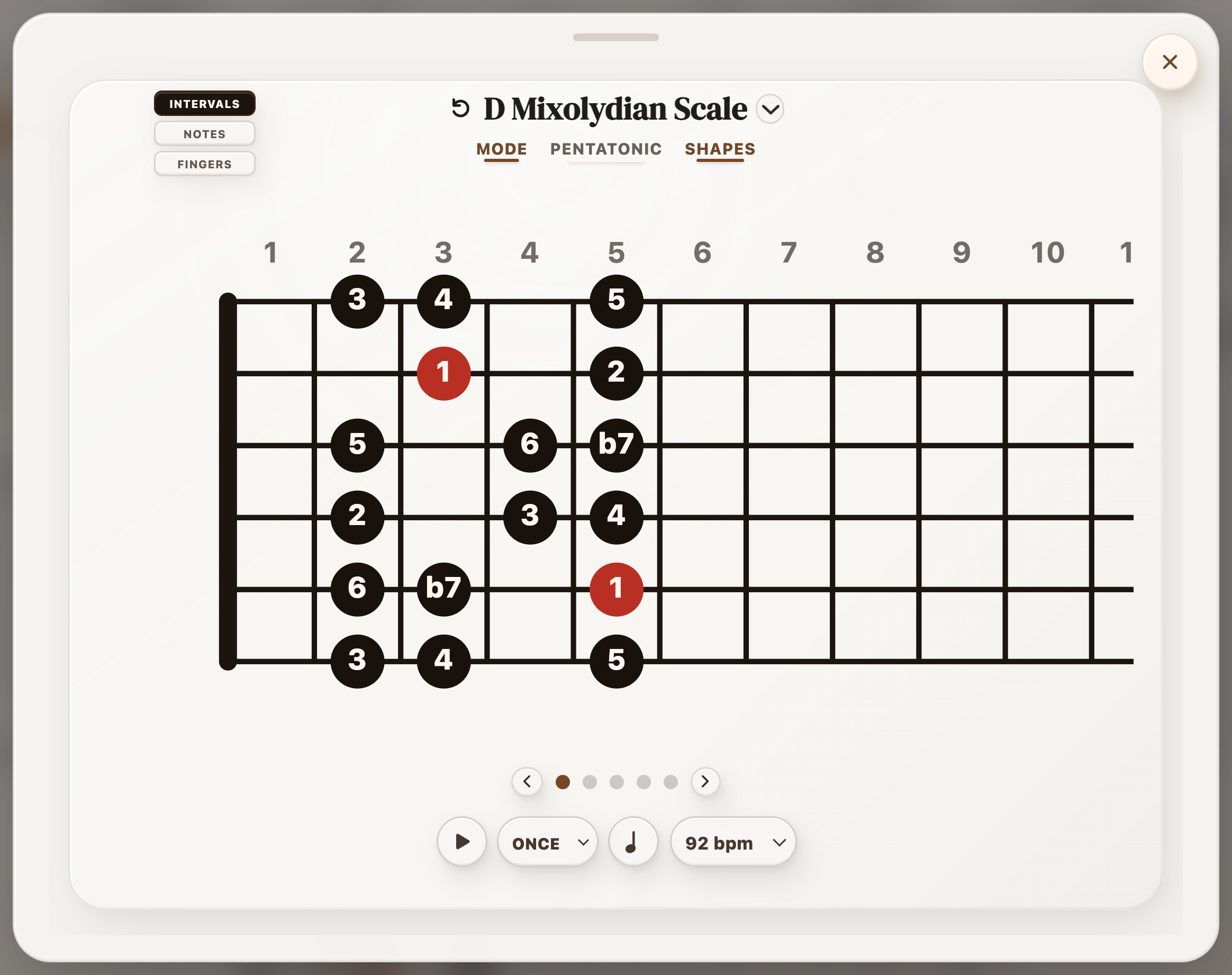
Each loop keeps a major tonal center while using flat-seven color.
Keep the tonal center obvious, then listen for the note or chord that creates the modal color.
Treat the first chord as home when practicing mixolydian guitar progressions. Return to it often so the mode does not collapse into ordinary major or minor harmony.
Mixolydian sounds major but less resolved than normal major. The flat VII chord is the main signal, especially in I-bVII-IV-I vamps.
Use drones, repeated bass notes, and compact triads to make the modal center clear. Busy cadences can hide the sound you are trying to practice.
Build short phrases around chord tones first, then land on the mode color note deliberately so the scale shape becomes musical.
| When you need... | What to do on guitar |
|---|---|
| To get the idea under your hands | Play one mixolydian guitar progressions example slowly with a single voicing family before changing anything else. |
| To make the part cleaner | Fix the weakest chord change or rhythm accent first, then return to the full progression. |
| To make it your own | Change one variable at a time: key, capo position, rhythm, register, chord color, or scale focus. |
| To test it in StrumForge | Open a related loop when you want diagrams, groove playback, and timing practice. |
Use the page as a starting point, then move into the app when you need sound, timing, diagrams, and scale context.
Short answers for players using this page as a practice or writing reference.
Start with one four-chord loop, slow the tempo down, and keep the same voicing family until the rhythm and chord changes feel automatic.
Yes. Each linked example opens a four-chord progression in the generator and counts toward the current 5 free daily progression generations.
Yes. Once the loop works, change key or capo position so the idea becomes a fretboard exercise instead of a memorized shape.