

Sound difference
Most nostalgic guitar progressions need one clear identity: lift, pressure, release, drift, weight, shimmer, or forward motion. Choose the example whose first chord and final return match that goal.
Guitar chord progressions
Explore nostalgic guitar progressions with guitar-focused examples, voicing notes, practice suggestions, songwriting angles, and direct StrumForge generator links.
Want more nostalgic ideas? StrumForge Premium includes a Nostalgic Style for generating your own progressions.
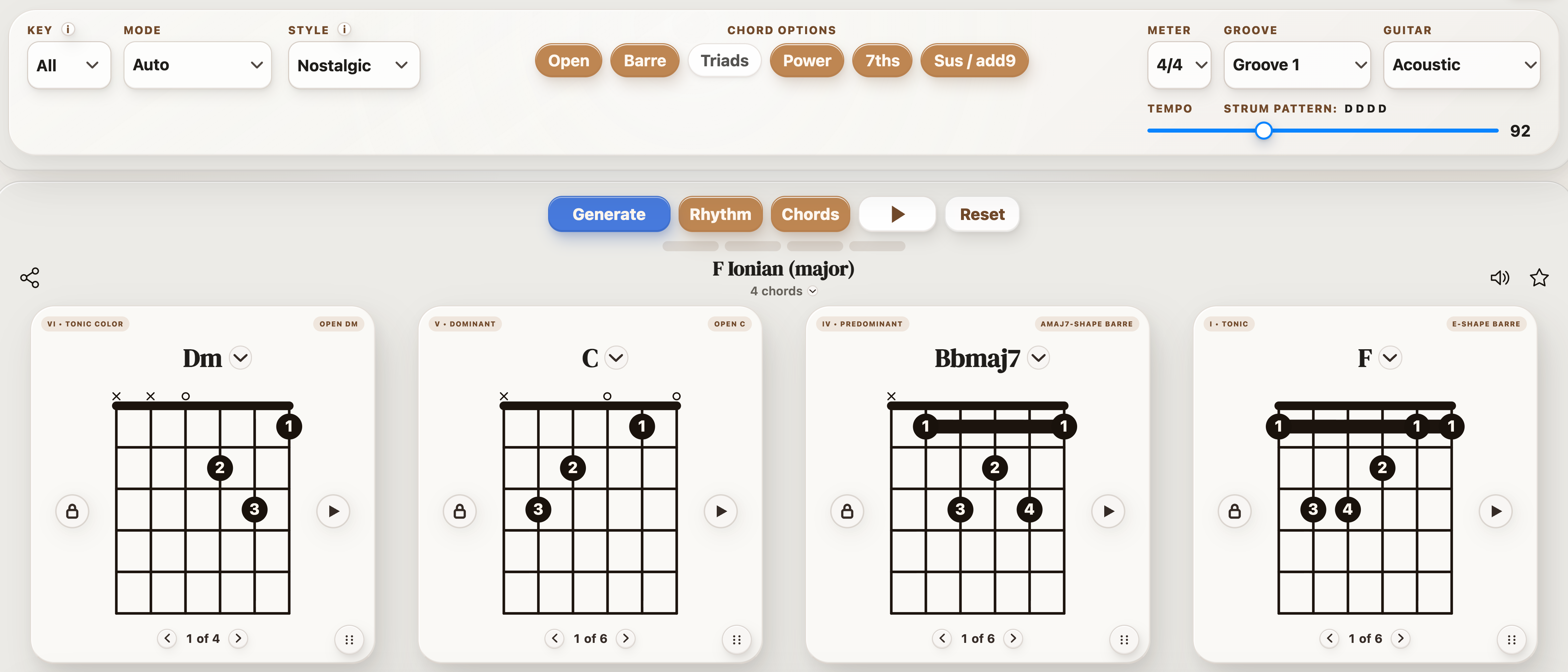
Use these four-chord examples as guitar-friendly starting points. Opening a linked loop in StrumForge counts toward the current 5 free daily progression generations.
Use these guitar-specific checkpoints to turn nostalgic guitar progressions into a playable rhythm part, practice loop, or songwriting prompt.
Most nostalgic guitar progressions need one clear identity: lift, pressure, release, drift, weight, shimmer, or forward motion. Choose the example whose first chord and final return match that goal.
Try straight downstrokes, down-down-up-up-down-up, muted eighth notes, slow arpeggios, or one sustained chord per bar before adding a busier groove.
Beginner version: 60-80 bpm with open or simplified shapes. Intermediate version: 80-115 bpm with triads, barre shapes, added color tones, or a capo change.
Do not keep adding chords when the part feels weak. First change the rhythm, register, top note, or voicing family.
Open one nostalgic guitar progressions example, slow the tempo, compare open and triad shapes, then change only one chord or voicing before regenerating.
| When you need... | What to do on guitar |
|---|---|
| To get the idea under your hands | Play one nostalgic guitar progressions example slowly with a single voicing family before changing anything else. |
| To make the part cleaner | Fix the weakest chord change or rhythm accent first, then return to the full progression. |
| To make it your own | Change one variable at a time: key, capo position, rhythm, register, chord color, or scale focus. |
| To test it in StrumForge | Open a related loop when you want diagrams, groove playback, and timing practice. |
Use the page as a starting point, then move into the app when you need sound, timing, diagrams, and scale context.
With StrumForge Premium, select Nostalgic in the Style menu to generate more ideas. Set Mode to Auto for a broad starting point. Try 7ths and Sus / add9, then compare a major-key opening with a minor-first idea. Keep the voicings and rhythm that support the memory or mood you want to express. Style guides new progressions within your selected key, mode, and chord options.
Short answers for players using this page as a practice or writing reference.
Start with one four-chord loop, slow the tempo down, and keep the same voicing family until the rhythm and chord changes feel automatic.
Yes. Each linked example opens a four-chord progression in the generator and counts toward the current 5 free daily progression generations.
Yes. Once the loop works, change key or capo position so the idea becomes a fretboard exercise instead of a memorized shape.