

StrumForge
Guitar-first progression generation, diagrams, groove playback, voicing choices, scale views, and practice flow.
Use it when you want to generate, hear, and play a guitar progression without rebuilding the session elsewhere.
Tool comparison
Compare StrumForge and ChordChord for guitarists by workflow, playback, chord diagrams, practice value, templates, and broader music-making features.
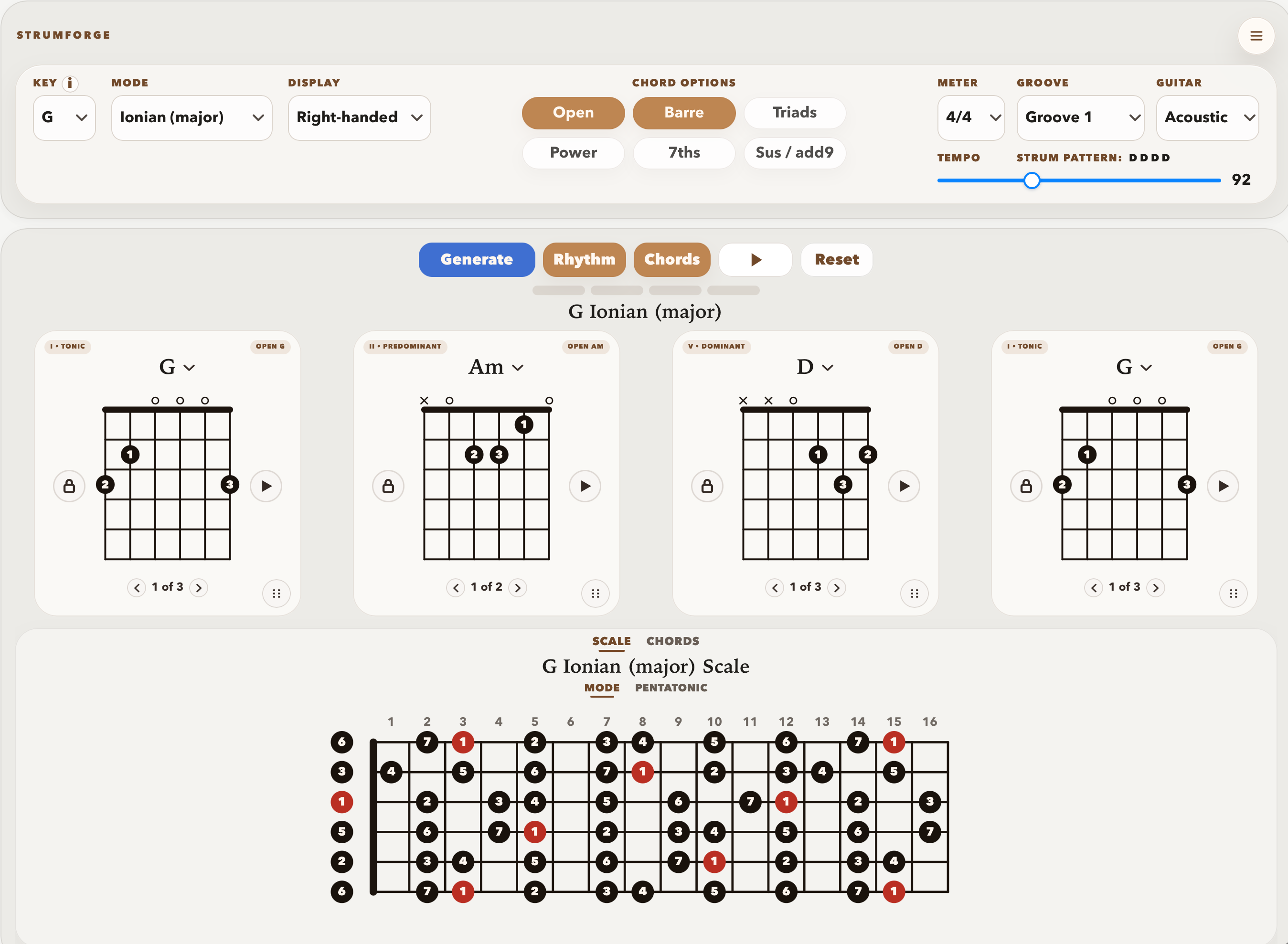
Choose StrumForge if you want a guitar-first progression generator with playable chord diagrams, groove playback, voicing controls, tempo control, and scale context. Choose ChordChord if you want a broader chord progression and music-maker workflow with templates, learning surfaces, and production-adjacent tools. For a guitarist sitting with an instrument, StrumForge is the more direct route from generated chords to a playable practice loop.
Both tools can help with chord ideas. They differ most in how quickly the idea becomes a playable guitar part.
Guitar-first progression generation, diagrams, groove playback, voicing choices, scale views, and practice flow.
Use it when you want to generate, hear, and play a guitar progression without rebuilding the session elsewhere.
Broader chord progression and music-maker surface with Chord Studio, templates, Learn Chords, and track separation navigation.
Use it when you want a general chord idea tool or template-led music-making workflow.
These notes focus on real use, not feature-counting. The useful question is what each tool helps a guitarist do next.
Better for guitar practice and playable songwriting starts.
StrumForge keeps the idea tied to the instrument. You can generate a loop, hear it, follow guitar diagrams, adjust voicings, and use scale context without leaving the page.
It is intentionally narrower than a general music-maker surface.
Better for a broader chord-tool environment.
ChordChord makes sense when you want a general chord progression surface, templates, learning material, or other music-making features around chord ideas.
For a guitarist who wants playable diagrams and a loop to practice now, it is a less direct path.
Use this as the fast decision guide before opening another app or rebuilding the same idea somewhere else.
| Decision point | Recommendation |
|---|---|
| You are holding a guitar and want to play | Choose StrumForge. It gets from generated progression to diagrams, playback, and practice faster. |
| You want a broader chord tool with templates | Choose ChordChord. It is less narrowly guitar-first and may fit a more general idea workflow. |
| You need to hear and revise one loop repeatedly | Choose StrumForge. It is built around listening, changing voicings, and keeping the progression playable. |
| You are comparing tools for a beginner guitarist | Choose StrumForge first. Diagrams and timed playback make the next action clearer than chord names alone. |
| You are not sure yet | Start with StrumForge if the next step is practice. Start with ChordChord if the next step is browsing general chord ideas. |
This is not a question of which tool is universally better.
StrumForge is the better fit when the next action is physical: put your fingers on the guitar, hear the loop, slow it down, change a voicing, and practice the transition. Its value is that the chord idea stays attached to sound, timing, and fretboard shape.
ChordChord is a better fit when you want a more general chord progression workspace. If the guitar is only one part of a wider production or template-driven writing session, that broader surface can be useful.
This comparison checks the public product pages against a guitarist's actual sequence: find the loop, hear it, play the shapes, revise the weak spot, then decide whether the idea should become a practice drill, song section, or recording.
| Tool | What we looked at |
|---|---|
| ChordChord | Reviewed the public ChordChord page for Chord Studio, templates, Learn Chords, and track separation navigation. |
Short answers for players using this page as a practice or writing reference.
For guitar-first practice and songwriting, yes. StrumForge is more focused on playable guitar diagrams, groove playback, voicing choices, and scale context.
ChordChord is broader than StrumForge and may be a better fit when templates or general music-maker features matter more than guitar-specific practice.
Yes. A guitarist could use ChordChord for a broad chord idea and StrumForge when the goal is to turn a loop into something playable on guitar.
Beginners who want to practice chord changes will usually get more immediate value from a guitar-first tool that shows diagrams and plays the loop in time.