 StrumForge


GUITAR SCALES · CAGED SYSTEM
CAGED system explained:
Minor pentatonic scale shapes
Learn how the five CAGED chord shapes relate to minor pentatonic scales. Compare each reference chord with the same shape played as A minor, then see how it fits inside the scale.
These CAGED shapes work in any minor key. A minor is the default example.
CAGED BASICS
What is the CAGED system?
The CAGED system, also called the CAGED method, maps the guitar fretboard using five movable chord forms: C, A, G, E and D. These forms connect different positions of the same chord. Each chord shape helps you locate the scale notes around it.
For minor pentatonic, use the minor versions of those forms: Cm, Am, Gm, Em and Dm. Each section starts with a reference chord so you can see the original shape. The next diagram uses that shape to play A minor, followed by the scale around it.
The letter names the shape. Am names the chord you hear. Moving a chord shape lets you play different chords, while its CAGED name stays the same.
How to read the chord and scale diagrams
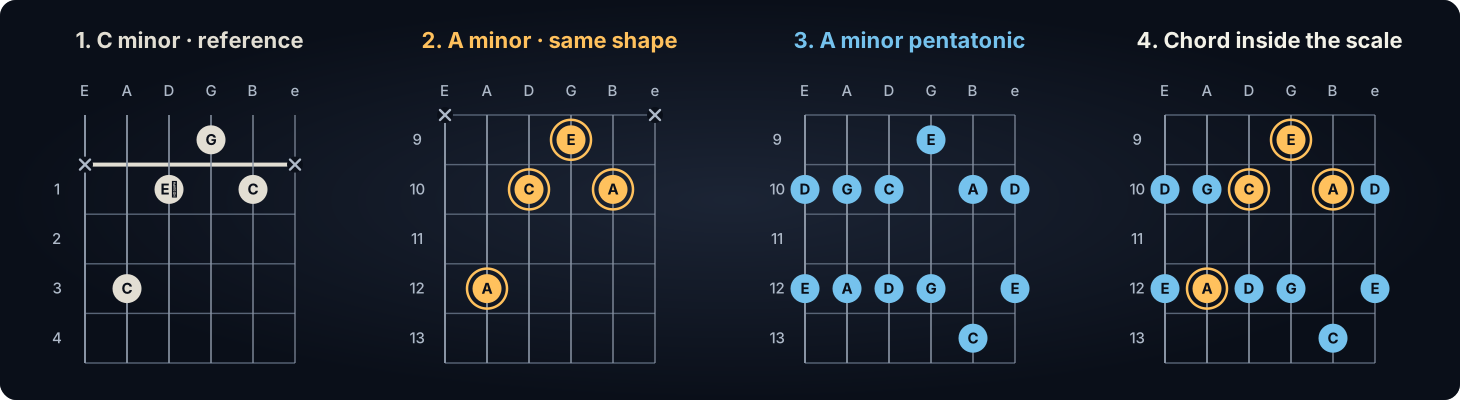
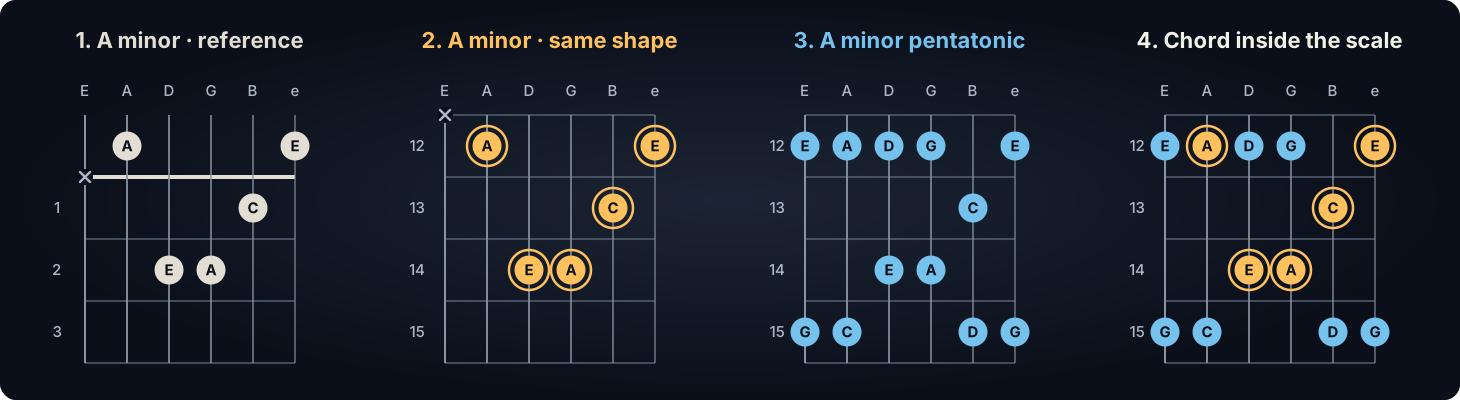
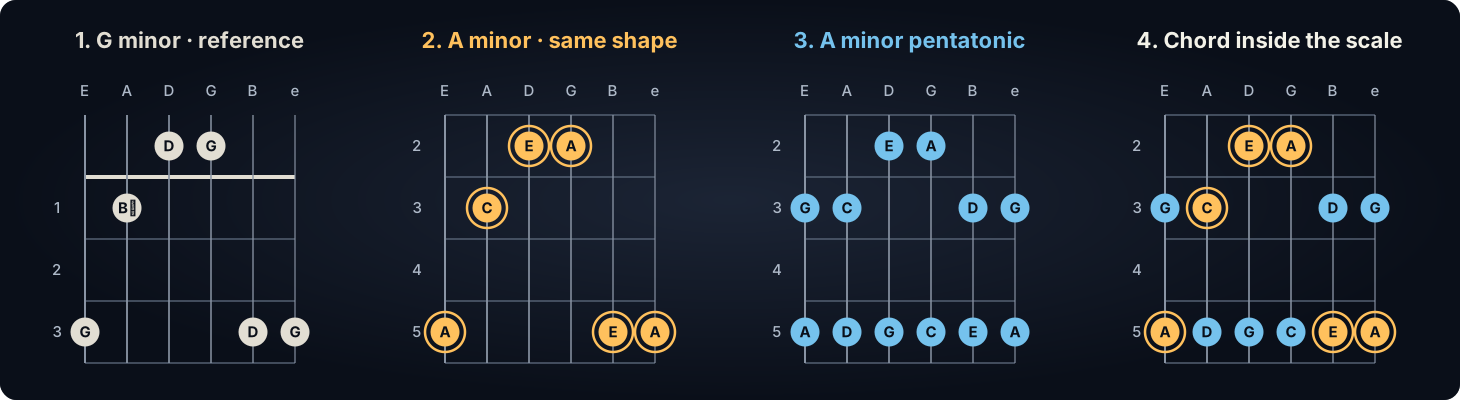
Read the four numbered diagrams in order: reference chord → A minor chord → A minor pentatonic → overlap. Gold follows the A minor chord; blue shows the scale.
Low E is on the left, high e on the right. The reference chord shows where the shape gets its name.
01 / FIVE CHORD SHAPES
The C shape in A minor
- Start with the C minor chord shown first.
- Use that same shape to play A minor farther up the neck.
- The C-shaped chord inside the scale gives this position its name.
Chord and scale diagrams
See it in action
02 / FIVE CHORD SHAPES
The A shape in A minor
- Start with the familiar open A minor chord.
- The next diagram shows that same shape higher up the neck.
- The A-shaped chord inside the scale gives this position its name.
Chord and scale diagrams
See it in action
03 / FIVE CHORD SHAPES
The G shape in A minor
- Start with the G minor shape shown first.
- Use that same shape to play A minor farther up the neck.
- The G-shaped chord inside the scale gives this position its name.
Chord and scale diagrams
See it in action
04 / FIVE CHORD SHAPES
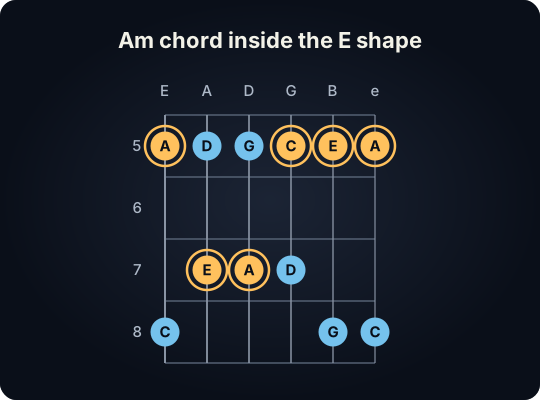
The E shape in A minor
- Start with the familiar open E minor chord.
- Use that same shape to play A minor farther up the neck.
- The E-shaped chord inside the scale gives this position its name.
Chord and scale diagrams
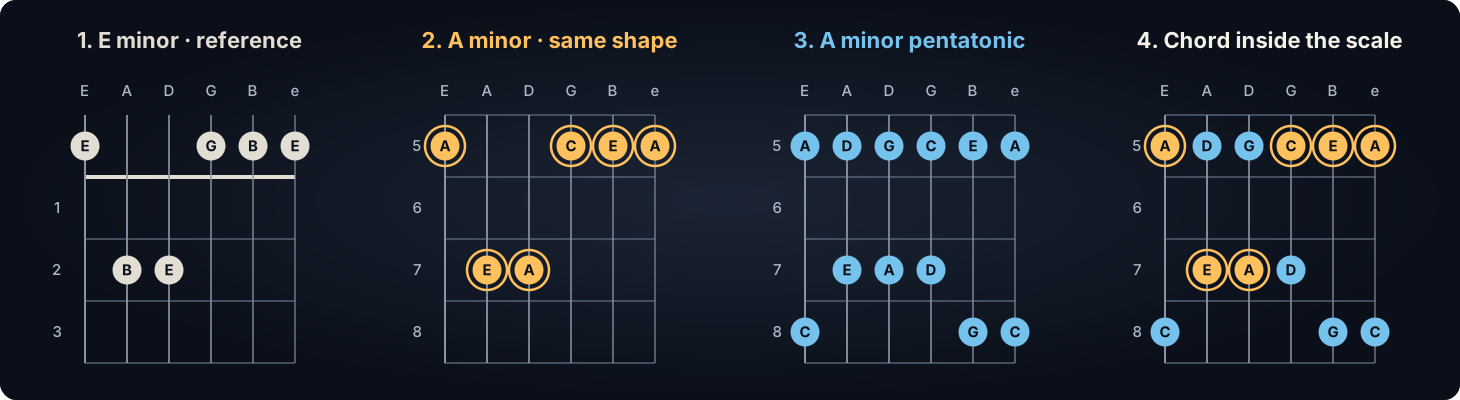
See it in action
05 / FIVE CHORD SHAPES
The D shape in A minor
- Start with the open D minor chord.
- Use that same shape to play A minor farther up the neck.
- The D-shaped chord inside the scale gives this position its name.
Chord and scale diagrams
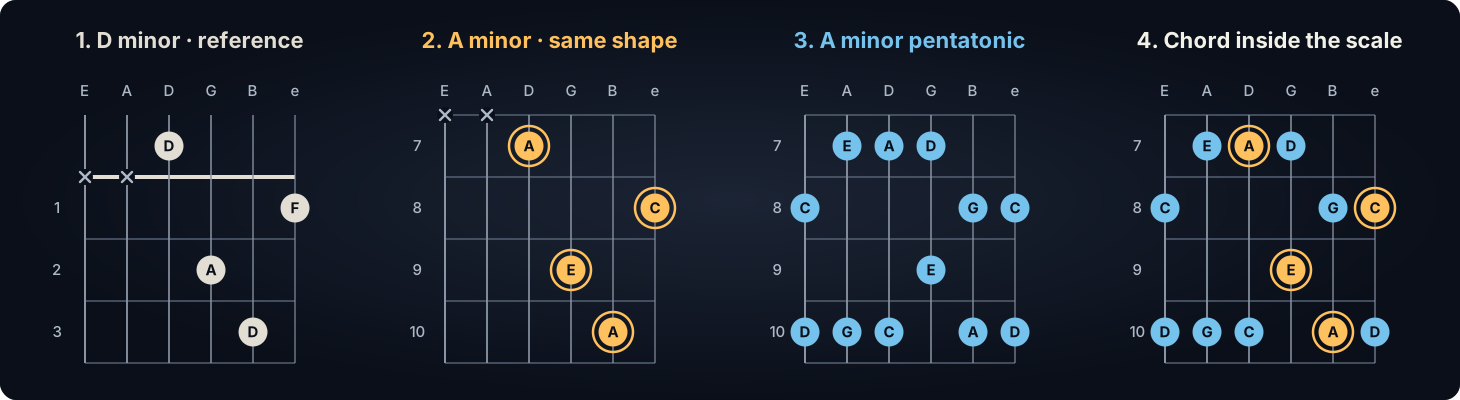
See it in action
CAGED SCALE POSITIONS
The five A minor pentatonic positions
For A minor, the positions shown run G → E → D → C → A up the neck. This is the repeating C–A–G–E–D cycle, starting at G. Neighboring patterns share notes; these are overlapping positions of the same scale.
The fret ranges are the complete scale positions, not just the chord frets. At fret 12, the open-position pattern repeats an octave higher.
GUITAR PRACTICE
How to practice CAGED minor pentatonic shapes
Start with the E shape. Practice the chord and scale separately, then play a short phrase over the Am chord.
- Find the roots. Locate every A in that shape. Play each one and say its name.
- Pick out the chord. Play A, C and E one note at a time. Use a smaller part of the chord if the full shape is a stretch.
- Add the scale. Bring in D and G. Make a short phrase, then resolve it to A over the Am chord.
- Try the next shape. Find the same notes in the D shape. Keep your rhythm and melody while changing the fingering.
CAGED QUESTIONS
CAGED scales & chord shapes: common questions
Why is it called the C shape when the chord is Am?
The first diagram shows the C minor reference chord. The next shows that same shape moved to play A minor. C names the shape it came from; A minor names the chord you hear.
What is the CAGED method on guitar?
The CAGED method is another name for the CAGED system. It maps the fretboard using five chord forms: C, A, G, E and D. Movable versions of these forms connect the same chord across the neck and provide landmarks for related arpeggios and scale positions.
Do these CAGED shapes work in every minor key?
Yes. The same five shapes work in every minor key. Moving a shape changes the chord and scale you play, while its CAGED name stays the same. A minor is the default example in this guide.
How does CAGED work with minor pentatonic scales?
Use the minor versions of the C, A, G, E and D chord forms. Locate the minor chord in each region, then learn the surrounding minor pentatonic notes. In A minor, the chord notes are A, C, E; the pentatonic scale is A, C, D, E, G.
Does the E shape mean I am playing in E minor?
No. E shape tells you which chord shape you are using. Its position determines the chord you play. The selected E-shape example shows A minor pentatonic around a A minor chord.
Are major and minor CAGED scale shapes the same?
A shared CAGED letter refers to the same chord-form family, but major and minor versions use different chord and scale notes. Relative scales can share the same fretboard dots with different names: the E form for A minor pentatonic is the G form for C major pentatonic, because their tonic chords differ.
Are CAGED shapes the same as pentatonic boxes?
They can describe the same five pentatonic regions from different viewpoints. A box number labels a pattern in a chosen teaching sequence; a CAGED letter identifies its tonic chord form. Numbering conventions vary, so use the root and chord form to check a label.
Do I need to play the full C-minor and G-minor chord shapes?
No. Learn the root locations and use smaller, playable parts of the chord shapes to connect the chord with its surrounding scale.
Related guitar lessons
Lesson notes & references. Diagrams follow StrumForge’s minor pentatonic models in standard tuning; animations and stills show the same selected voicings. For further background, see Applied Guitar Theory’s minor CAGED guide and Fretboard Foundation’s pentatonic forms. You can use smaller parts of the C- and G-minor chord shapes if the full shapes are difficult to play.