

Guitar practice
Guitar Scale Practice: Positions, Sequences & Clean Technique
Guitar scale practice starts with knowing which notes you are playing and producing them cleanly in time. Work on one position before adding sequences, faster rhythms, or shifts. This guide develops control of the shape; the companion guide applies those notes over changing chords.
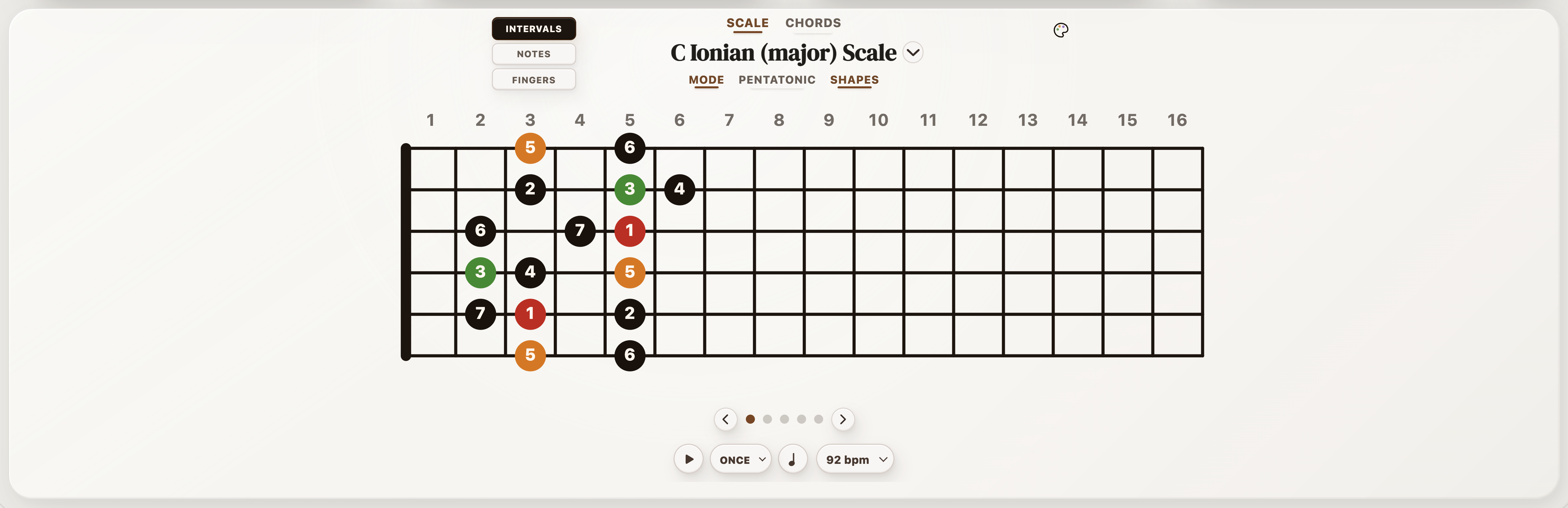
Learn a small C major position
Use Standard tuning. String 1 is the thin high E. Play the following notes in order for one octave of C major, beginning on string 5. The finger numbers are a suggested starting fingering: 1 is index, 2 middle, 3 ring, and 4 little finger.
Swipe or scroll sideways to see all columns.
| Note | String | Fret | Suggested finger |
|---|---|---|---|
| C | 5 · A | 3 | 3 |
| D | 4 · D | 0 | Open |
| E | 4 · D | 2 | 2 |
| F | 4 · D | 3 | 3 |
| G | 3 · G | 0 | Open |
| A | 3 · G | 2 | 2 |
| B | 2 · B | 0 | Open |
| C | 2 · B | 1 | 1 |
Play C–D–E–F–G–A–B–C, then descend. Name each note before playing it. Keep unused strings quiet and listen for equal volume between open and fretted notes. If alternating pick strokes is too much at first, use slow downstrokes while learning the locations.
This compact open-position exercise is independent of the app’s CAGED shape numbering. It gives you a small note set to understand before choosing a larger displayed shape.
Six scale practice drills with a clear purpose
Swipe or scroll sideways to see all columns.
| Drill | What to play | What it teaches |
|---|---|---|
| Slow ascent and descent | C–D–E–F–G–A–B–C, then back. | Note locations, consistent volume, and string crossings. |
| Ascending thirds | C–E, D–F, E–G, F–A, G–B, A–C. | Hearing intervals instead of only adjacent notes. |
| Groups of three | C–D–E, D–E–F, E–F–G, F–G–A, G–A–B, A–B–C. | Keeping a repeating pattern through a string change. |
| Three-note phrase | Use C, D, and E; make five different rhythms. | Phrasing without learning more frets. |
| Root landing drill | End each short phrase on either C in the position. | Recognizing the tonic by ear and location. |
| One-string scale | On string 2, play frets 1, 3, 5, 6, 8, 10, 12, 13. | Seeing whole and half steps across the neck. |
In the one-string drill, the frets spell C–D–E–F–G–A–B–C. Shift the hand smoothly instead of stretching to hold the entire sequence. Pause between small groups if that helps you control the movement.
Change the rhythm before chasing speed
Start at 60 BPM with one note per beat. After a clean ascent and descent, keep the tempo and play two notes per beat. Count “1 & 2 &” continuously. Quarter notes at 60 BPM and eighth notes at 60 BPM are different playing speeds; record both tempo and subdivision in your notes.
Try a rest after every three notes. Then play a four-note group twice, with an accent first on its first note and then on its third. If the accent makes you rush, reduce its volume. Practice the string crossing that interrupts the phrase separately.
Practice with StrumForge’s scale playback
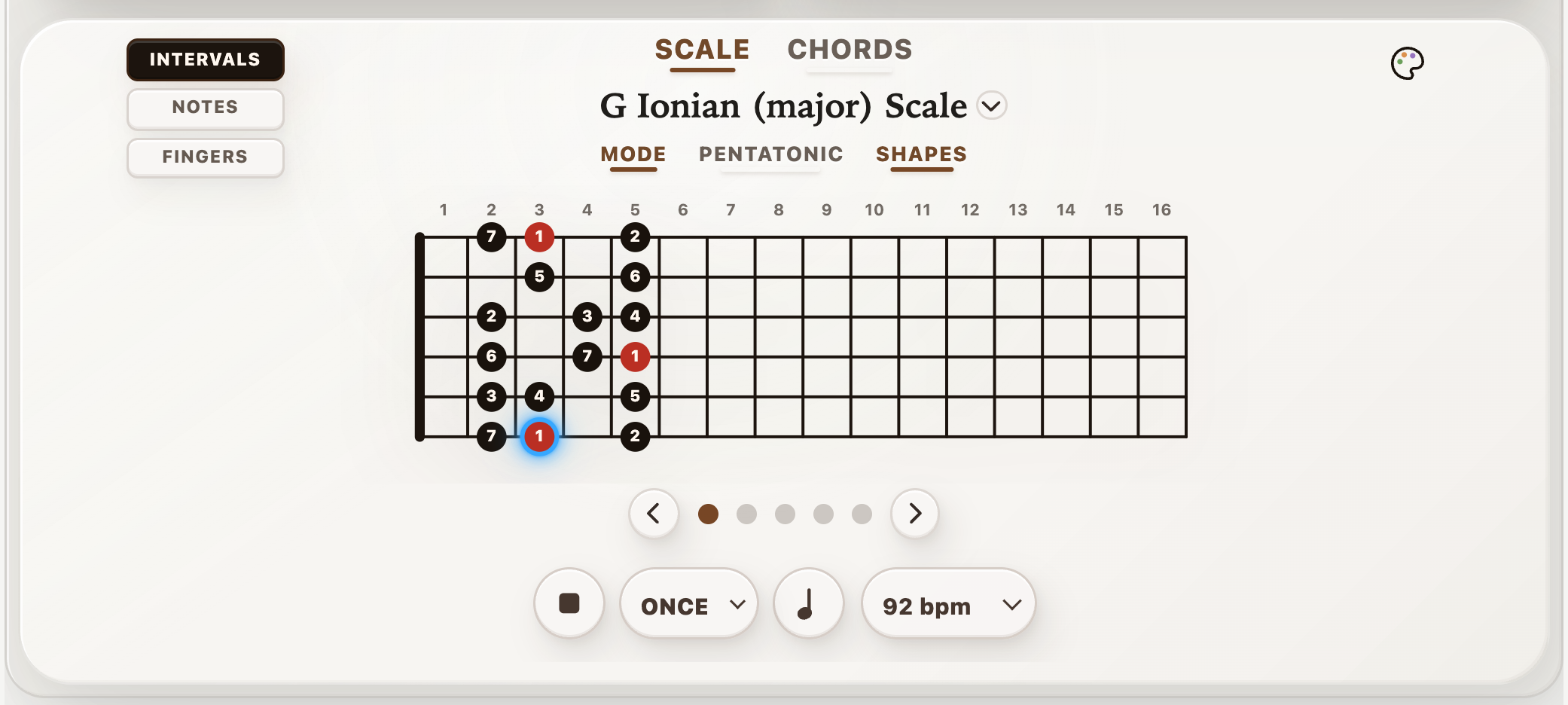
Choose a progression in your intended key, open its scale panel, and choose Shapes. Use note labels to learn the locations or interval labels to identify roots, thirds, and fifths. Select a comfortable practice tempo, then start note-by-note playback.
Use the playback scope to repeat the current shape before moving through all shapes. Follow the active note at first, then stop the guide and play the shape from memory. The screenshot below shows G major; choose C major when connecting the app to the note examples on this page.
These exercises work with a guitar and a steady pulse. StrumForge offers free progression generation within its daily allowance. Interactive triad and arpeggio trainers, advanced scale playback, the dedicated metronome, tuner, favorites, and practice tracking require StrumForge Pro. Compare the app features and access options.
Connect two positions with a phrase you already know
Choose four notes that you can find in both regions, such as C–D–E–G. Play them in the first position, pause, and find the same pitches in the second. Keep the rhythm unchanged. A new fingering should not force you to invent a new phrase at the same time.
Next, use a shared note as the handoff between positions. Say its name and notice which finger plays it before and after the shift. If you lose the root, return to a single position and locate every C.
For a smaller map of the harmony, use triad inversions. For single-note chord patterns across CAGED forms, use the Arpeggio Trainer.
A ten-minute technique session
Swipe or scroll sideways to see all columns.
| Minutes | Task | Pass condition |
|---|---|---|
| 0–3 | Name and play the C major octave slowly. | All notes ring cleanly in both directions. |
| 3–5 | Choose thirds or groups of three. | The pattern stays intact over string changes. |
| 5–7 | Use three notes with several rhythms and rests. | The pulse continues through the gaps. |
| 7–9 | Move the same short phrase to another position. | You know the note names in both places. |
| 9–10 | Play one phrase over a chord and note a weak spot. | You can describe the next task precisely. |
When should I practice over chord changes?
As soon as you can find a few notes without losing the beat. You do not need every scale shape first. Continue with scales over chord progressions to learn which notes to emphasize as the harmony moves.
Choose your next practice guide
For the complete product tour, visit the guitar practice app page. For focused fretboard work, explore Triad Trainer and Arpeggio Trainer.