

Guitar lessons · Updated September 11, 2026
Guitar Triad Trainer: Shapes, Inversions & Practice
A guitar triad contains three different notes: a root, a third, and a fifth. Learn one chord on one string set first, then connect its inversions. StrumForge’s Triad Trainer shows those shapes together and lets you hear them strummed or one note at a time.
Open Triad TrainerFree preview · Interactive controls and playback require Pro
Start with C major on the three highest strings
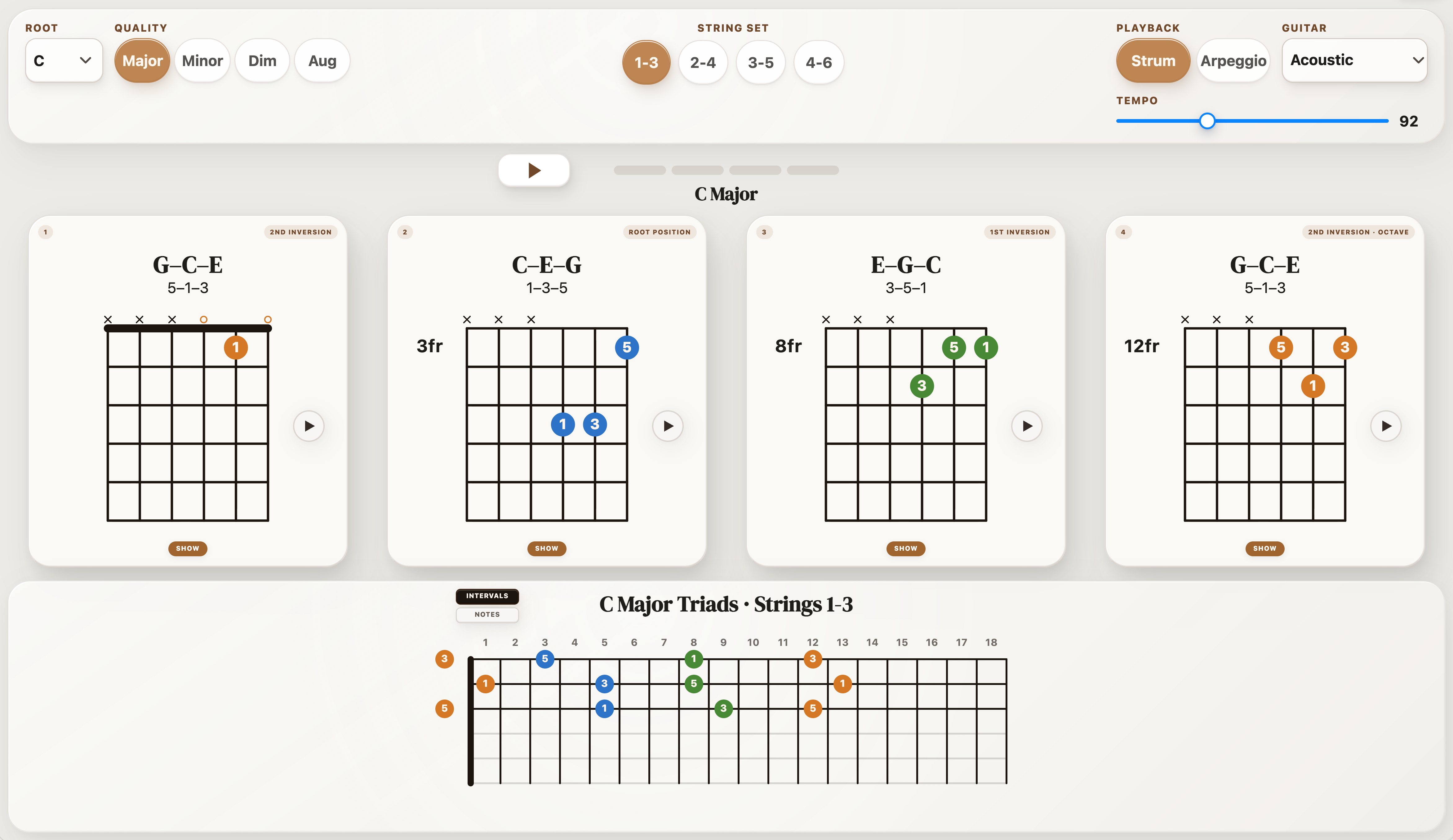
Standard tuning; string 1 is the thin high E. Play only strings 3, 2, and 1. Read the frets below in that order, from G string to high E. The lowest sounding note determines the inversion.
| Voicing | Frets: G / B / high E | Notes, low to high | Bass note |
|---|---|---|---|
| C/G · second inversion | 0 / 1 / 0 | G–C–E | G, the fifth |
| C · root position | 5 / 5 / 3 | C–E–G | C, the root |
| C/E · first inversion | 9 / 8 / 8 | E–G–C | E, the third |
| C/G · second inversion, octave higher | 12 / 13 / 12 | G–C–E | G, the fifth |
Sound each note separately, then strum the three together. Say the bass note before moving. These are four positions but only three inversion types: the second inversion repeats an octave higher.
Hear what changes between triad qualities
| Quality | Formula | C example | What changes |
|---|---|---|---|
| Major | 1–3–5 | C–E–G | Starting reference |
| Minor | 1–♭3–5 | C–E♭–G | Lower the major third one fret |
| Diminished | 1–♭3–♭5 | C–E♭–G♭ | Lower the third and fifth |
| Augmented | 1–3–♯5 | C–E–G♯ | Raise the fifth |
Keep the root fixed when comparing qualities. Listen to the changed note rather than treating every diagram as an unrelated grip. Augmented triads are symmetrical, so their shapes repeat every four frets; the selected root still determines the interval labels.
A ten-minute triad practice routine
- Minutes 1–3: Choose C major and strings 1–3. Play each position once, naming C, E, and G.
- Minutes 4–5: Move through the inversions slowly. Keep unused strings quiet and make all three notes speak clearly.
- Minutes 6–7: Change to C minor. Find every E that becomes E♭.
- Minutes 8–10: Choose strings 2–4 and rebuild the same exercise. Stop and name the bass note before each shape.
Next, connect C, F, and G using nearby inversions. Choose the next shape by the shortest comfortable movement, not automatically by its root position. The guitar voicings guide explains how smaller shapes fit into an arrangement.
Use the trainer while you practice
Select a root and major, minor, diminished, or augmented quality. Choose strings 1–3, 2–4, 3–5, or 4–6 to see four connected positions. Use strummed or arpeggiated playback at 50 to 180 BPM. Strummed playback lets you compare the complete sound, or arpeggiated playback to check the individual chord tones. Slow the tempo until you can move with the sequence.
This trainer is part of the StrumForge cross-platform guitar practice app, available on web, iPhone, iPad, and Android, alongside progression playback, scales, a metronome, and a tuner.
You can open the trainer preview for free. Interactive trainer controls and playback require StrumForge Pro. Practice preferences are saved on this device.
Connect triads to progression playback
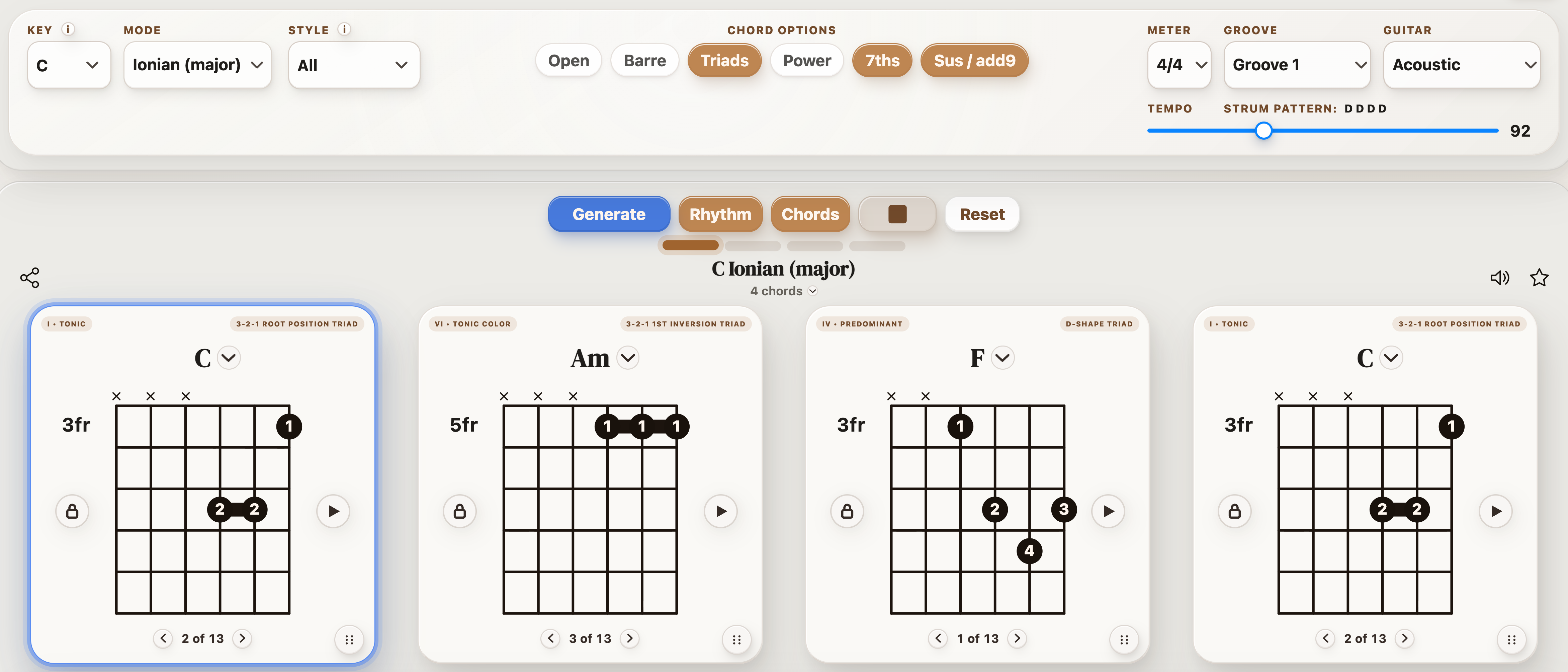
Select Triads in Chord Options and generate a progression to hear compact voicings in time. In this C–Am–F–C example, compare the shared notes between C and Am, then listen to how the F chord leads back to C. Follow the highest note of each shape as a short melody.
See the triad inside the surrounding scale
Open a C major scale shape and choose Triad highlighting from the Note colors menu. The colored 1, 3, and 5 markers identify C, E, and G—the same notes you learned in the C major triad. The remaining scale notes stay visible so you can practice connecting one chord tone to the next.
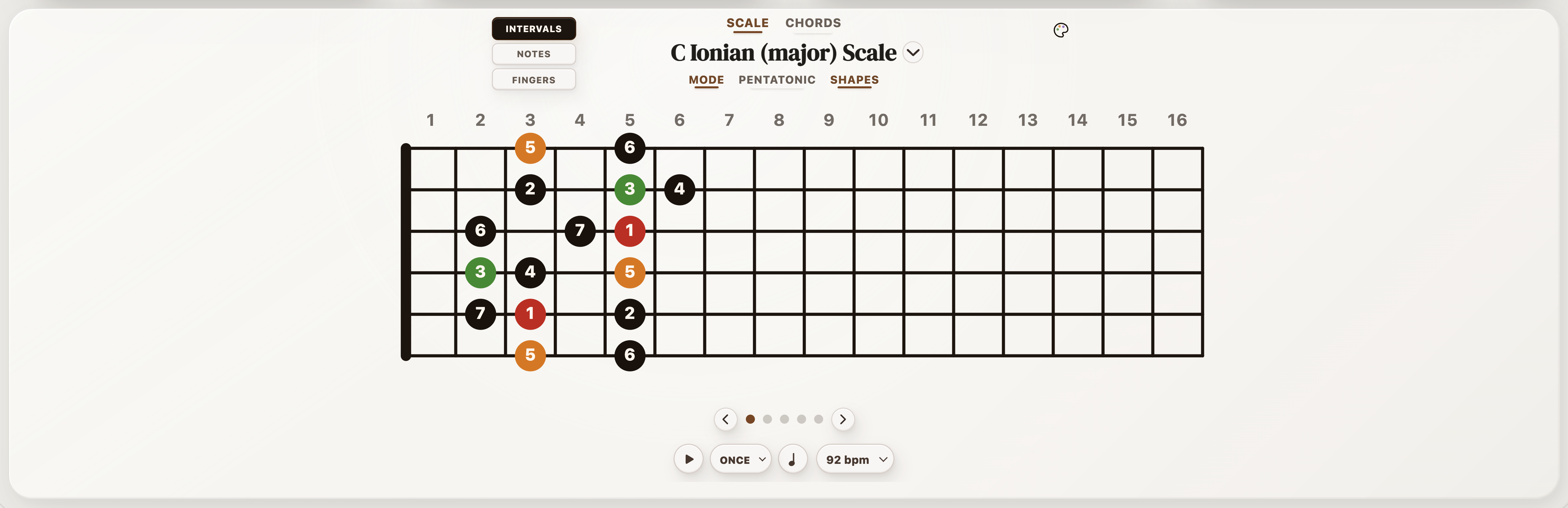
Start a phrase on a colored note, pass through a nearby scale note, and resolve to another colored note. Then return to the chord loop and listen for those tones over C. Continue with scale practice.
Triads or arpeggios: what should you practice next?
A triad is a three-note chord; an arpeggio is a way of playing chord tones separately. You can arpeggiate a triad, and you can also arpeggiate four-note seventh chords. Use this trainer for compact chord shapes and inversions. Use the Arpeggio Trainer lesson to connect chord tones across CAGED positions and practice single-note timing.